
 en
 русский
 Español
 Deutsch

Multifunctional Tool Bag Sourcing Guide for Professional Buyers and Brands
Buyer's Brief
Multifunctional Tool Bags: How to Specify One That Survives the Job Site
Pocket counts are the least useful number on a spec sheet. Carry system, access architecture, base construction and trade fit decide whether a multifunctional tool bag earns its place on a crew.
Most multifunctional tool bag complaints begin with the same mismatch. The buyer specified pockets; the user needed a workflow. A 42-pocket bag still frustrates an electrician who has to open three separate panels to reach a voltage tester, while a 12-pocket tote suits an installer who never carries more than one tray at a time.
So the working definition has to be functional rather than decorative. A multifunctional tool bag serves more than one task sequence without being emptied, re-sorted or parked on the ground. That ability comes from engineering choices, not catalogue copy.
Four decisions define a multifunctional tool bag
If you have time to review only four things before approving a sample, review these. Colour, logo placement and packaging matter commercially; they rarely decide whether the bag comes back as a warranty claim.
- Carry system. Hand, shoulder, back, waist or wheels. This choice sets the realistic maximum load, the working height of the bag and how often the user puts it down.
- Access architecture. Wide-mouth open reel, full clamshell zip, double-sided opening or layered front panels. Architecture decides how many hand movements separate the user from a tool; for repetitive diagnostic work, two is the practical ceiling.
- Base and frame. Hard base, rubber bottom, moulded foot pads, tubular steel handle or wire-reinforced rim. The base takes the load and the drop; the frame holds the mouth open so one-hand retrieval is possible.
- Retention and modularity. Pockets, loops, holsters, quick-release clips and detachable totes. Modularity is what lets one pattern cover several trades, but only when the fixings are rated for the tools that will hang from them.
Audit pockets before you count them. Count only the pockets a gloved hand can enter within two seconds at the height the bag is used. That figure usually lands 30 to 40 percent below the catalogue number, and it is the number your customers live with.
Match the carry family to the job, then to the range
Carry system is a purchasing decision rather than a preference, because it sets the ceiling on everything else: reach, balance, load and how the bag behaves on stairs, scaffolding and gravel. Most ranges sell better with two or three families than with one universal bag that does every job adequately and none of them well.
If you are weighing a backpack-led range against a tote-led range, this comparison of tool bag versus backpack behaviour on site is a useful starting point.
| Family | Working load | Best fit | Most common spec risk |
|---|---|---|---|
| Trolley or wheeled tote | 30 to 60 kg | Vehicle-to-site transport of heavy kits | Wheels and handles rated for smooth indoor floors only |
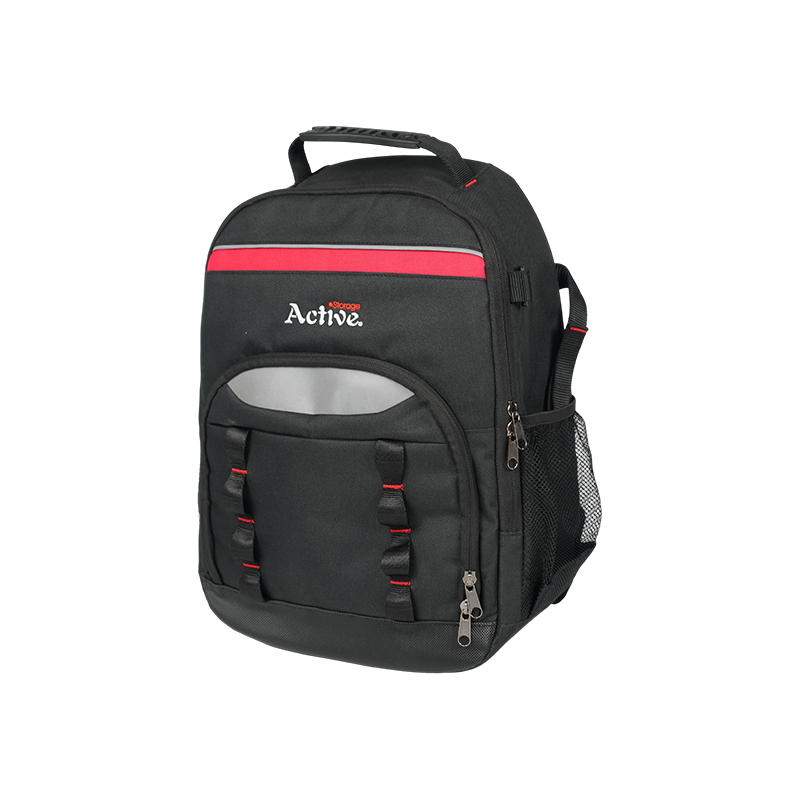
| Backpack | 15 to 25 kg | Ladders, stairs and long walks with a balanced load | Thin back panel and no frame sheet |
| Tubular-handle tote | 15 to 30 kg | Floor-level access for woodworking and installation | Handle rivets and base sag under load |
| Waist pack or pouch | 3 to 8 kg | Constant access while both hands are busy | Belt clip fatigue and stitching at stress points |
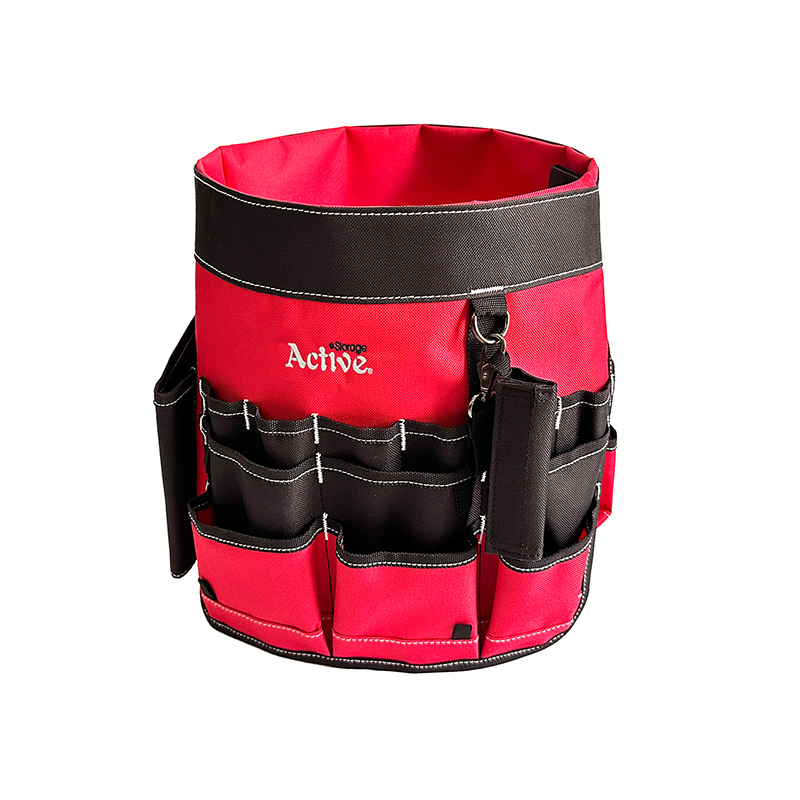
| Bucket organiser | 5 to 15 kg | Loose fasteners, fittings and mixed small parts | Collapsed rim and no rigid insert |
Buyers building a backpack-led assortment usually need one pattern that handles hard floors and device charging without changing the load structure. A hard-base backpack with a USB port covers that position.
Specifications that decide field life
Two bags can look identical in a photograph and behave completely differently after six months of daily use. These are the items worth locking into a written specification before tooling starts.
- Shell fabric. 600D polyester with a PU coating is the working standard. Heavier denier resists abrasion better but adds stiffness and cost, and a stiffer shell folds less flat in transit.
- Base construction. A polyethylene hard base handles standing water and rough ground, a rubber bottom adds grip and reduces noise, and moulded foot pads lift fabric clear of wet surfaces. All three fail if the base panel is not stitched through a reinforced skirt.
- Hardware. Specify #10 zips on main compartments, oversized sliders for gloved hands, and bartack reinforcement at every handle attachment and strap junction.
- Tolerances. Ask for dimensional and weight tolerances in writing. A 3 to 5 percent variance in finished height is normal across production runs, and exact dimensions printed in marketing material turn that variance into a claim.
A bag is only as strong as the seam where the handle meets the body. Test that joint at sample stage and the denier debate usually resolves itself.
Water-resistant is not waterproof. A coated polyester shell sheds rain and splashes; it will not protect tools in standing water. For all-weather users, specify a rubber or hard base, covered zips and a rain flap across the main opening.
Trade-specific variants do the real multifunctional work
In practice, most multifunctional ranges are trade-led. One variant is optimised for the dominant user group, and a longer tail of general-purpose patterns fills the gaps between them.
Electrical and low-voltage work
Highest pocket density, insulated loops and reinforced wide openings so testers, pliers and drills stay visible. Waist and pouch formats matter here because the user is often on a ladder with both hands occupied.
Woodworking and construction
Longer, shallower pockets for saws and squares, a rigid base that survives being dragged across a floor, and a mouth that opens fully at floor level so material lifts straight out.
Automotive repair and detailing
Fewer small pockets and more open volume for fluids, polishers and diagnostic gear, plus wheels or a trolley frame for movement between bays.
Garden and outdoor maintenance
Mixed sizing, open-top bins for hand tools and a construction that tolerates damp soil and repeated hosing down.
For general maintenance work, dense modular storage carried on the body often outperforms a large floor bag, because every tool stays within reach while the user moves.
What to verify before you commit tooling
Compliance and continuity checks rarely change the design, but they decide whether your tooling investment is recoverable.
- Sample validation. Load the sample to its rated weight, drop it onto a hard base corner, pull the handle repeatedly, cycle the main zip and inspect every seam. Record the result as a signed reference.
- Audit documentation. Third-party audits such as BSCI, SEDEX, FCCA and SCS cover social compliance and factory capability. They do not certify the quality of your specific SKU.
- Design ownership. Check registered designs and patents before copying a layout, and put co-development terms in writing when you and the factory refine a pattern together.
- Production continuity. Confirm which site will run your order and whether hardware, lining or QC procedures change between sites. Multi-site capacity only helps when specifications travel with the order.
- Transit protection. Drop-test the export carton, not just the bag. Most first-container damage happens before the product reaches a shelf.
It also helps to know who stands behind the sample. A tool bag manufacturer with in-house design, an owned factory and a documented audit history shortens the sampling loop considerably, because nothing sits between the drawing and the sewing line.
Never approve a sample that exists only as a sample-room article. If the approval piece was sewn off-line, treat the first production run as the real sample and inspect it accordingly.
A multifunctional tool bag is a commercial promise: one purchase, several jobs. Buyers who keep that promise keep it in four places, which are the carry system, the access architecture, the base construction and the retention strategy. Write those into the specification before tooling rather than after the first warranty claim, and pocket count becomes a detail instead of an argument.
Two carry families plus one trade-specific variant will usually cover most of a professional market. That is a range, not a compromise.






We are a professional enterprise engaged in exporting various types of toolkits.
We firmly believe that 'quality is everything, service enhances value'.
-
+86-15298800699

-
+86-512-58670375

-
karen@kun-bag.com

-
Building 11, No. 93 Chengang Road, Zhangjiagang City, Jiangsu Province, China

Copyright © Zhangjiagang Seaark Tools Industrial Co., Ltd. All Rights Reserved.
Custom Electrician Tool Backpack Manufacturers