
 en
 русский
 Español
 Deutsch

Pocket Handy Tool Bag: The Compact Workhorse Every Service Technician Needs
The Pocket Handy Tool Bag: Compact Carry, Professional Return
When a full tool backpack is too much and a waist pouch is too little, the pocket handy tool bag becomes the most-used carrier on the job. Here is what separates a well-built one from a bag that never leaves the van.
A technician walks into an apartment block for a routine maintenance call. He needs eight hand tools, a few terminals, a meter, and a carrier that opens without unloading everything twice. That profile turned the pocket handy tool bag into a steady export category, and it is why professional buyers evaluate this format differently from larger tool carriers.
Why the pocket handy tool bag earns its place on site
In most tool storage systems, the pocket bag is the cheapest layer per tool carried and the fastest to deploy. A worker can pull it from the van, set it on a stair tread, and have the right screwdriver in hand within three seconds. That access speed is not a comfort feature; it is a measurable productivity figure.
Across a service day, a five-second saving per tool fetch becomes real money. Four calls with twelve fetches each add up to roughly four extra minutes per technician per day — around one hundred hours a year for a ten-person crew.
The physical context matters too. Elevators too small for a trolley, rooftops reached by ladder, scaffolding decks with no safe place for a backpack — these are the environments where a compact footprint and a free hand make the pocket bag the only sensible option.
What defines a pocket handy tool bag
The term covers a family of compact carriers built around the reach-and-fetch motion, not a single fixed shape. In manufacturing catalogs, three attributes define the category: a footprint small enough to set down anywhere on site, an opening system that shows the contents at a glance, and a carry option that keeps one hand free.
- Compact footprint — 30 to 45 cm across when full, sized for a workbench, a van shelf, or the floor beside a ladder.
- Fast opening — a wide open-reel mouth or zippered panels that expose the central compartment without unpacking.
- Flexible carry — top handle, adjustable shoulder strap, or both.
- Stiff or rubber base — keeps the bag upright on wet floors and uneven ground.
- Organized interior — from three large compartments to twenty-plus pockets with elastic loops and tape holders.
"Handy" has a measurable meaning here. A bag is handy when it stays upright on uneven ground, opens fully without collapsing, and lets a tool be removed and returned with one hand. If any of those three actions fails, the bag is decorative rather than functional.
How the pocket bag compares to other carry formats
Buyers sometimes confuse this category with waist bags and full tool backpacks. The three formats follow different body motions, and each has a clear boundary.
| Comparison point | Pocket handy tool bag | Waist bag | Tool backpack |
|---|---|---|---|
| Typical capacity | 10–30 hand tools | 6–12 tools | 30+ tools, often with power tools |
| Access position | Bench, floor, van shelf | Hip level, attached to body | Back, or set down beside you |
| Best use case | Service calls, multi-floor rounds, scaffolding | Assembly lines, ladder work | Long walks between job stations |
| Weight distribution | One hand or shoulder | Waist and hips | Both shoulders |
| Opening style | Open top or zippered panels | Fingers to pouch | Side or top access |
A pocket bag will not replace a backpack when a hammer drill and a full bit set are needed. But for frequent in-and-out work, it opens faster than any backpack because it never has to be taken off first, and it carries more than a waist bag.
Buy for the worker's most frequent task, not for the heaviest job of the week. A pocket bag chosen for the wrong working motion will end up staying in the van.
Three pocket bag formats that cover most professional workflows
When a manufacturer builds pocket handy tool bags for export, the line-up usually falls into three structural families. Standardizing on these three covers most working habits without multiplying SKUs.
Open reel bag with adjustable shoulder strap
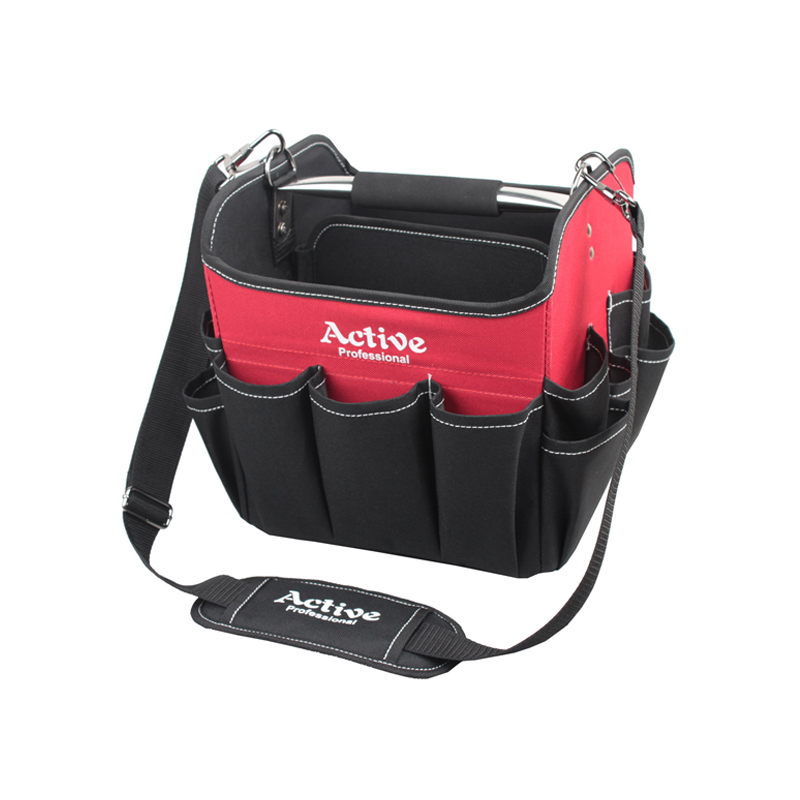
The open-reel format is the most common in export markets. It opens wide with no zipper in the way, so every tool stands upright and visible. The shoulder strap frees both hands between floors, and the stiff base resists tipping. It suits general maintenance, electrical, and plumbing work.
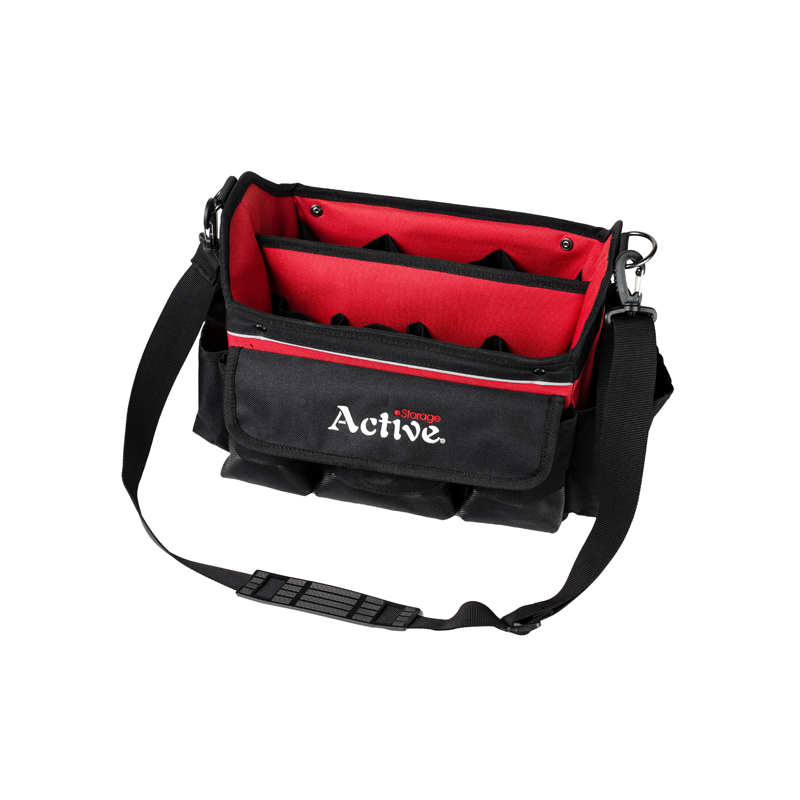 Heavy-Duty Open-Reel Tool Bag with Adjustable StrapOpen-reel design with stiff base and multiple pockets, ideal for electricians and plumbers needing quick access and durability.View Product →
Multipocket organizer with shoulder strap
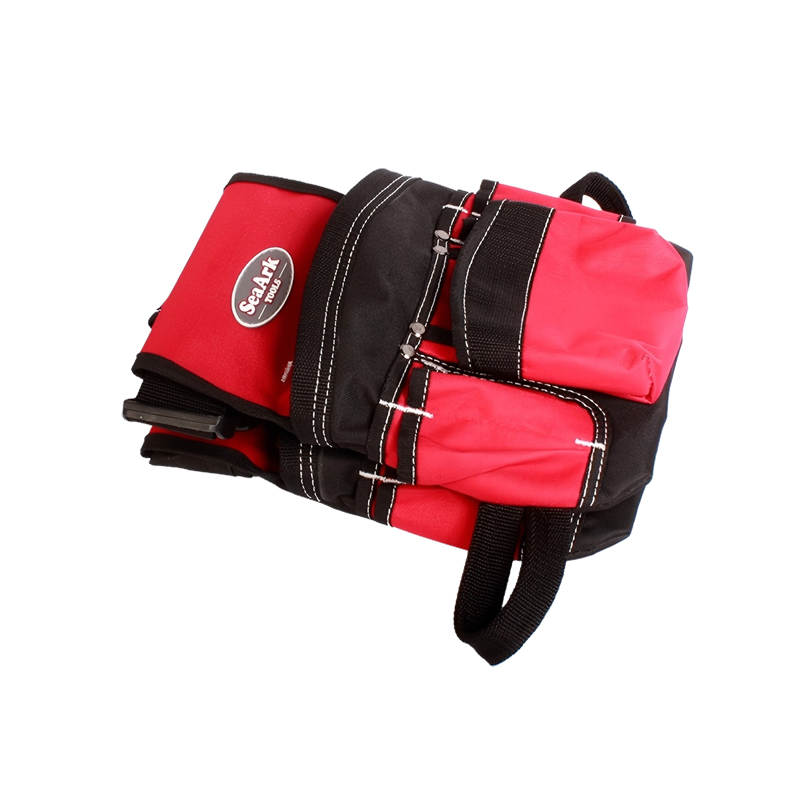
Workers who handle small parts — terminals, screws, cable clips — need separation more than open space. The multipocket variant puts elastic and zippered pockets around a central compartment, keeping small items in place. It is the preferred choice in electrical, HVAC, and low-voltage work.
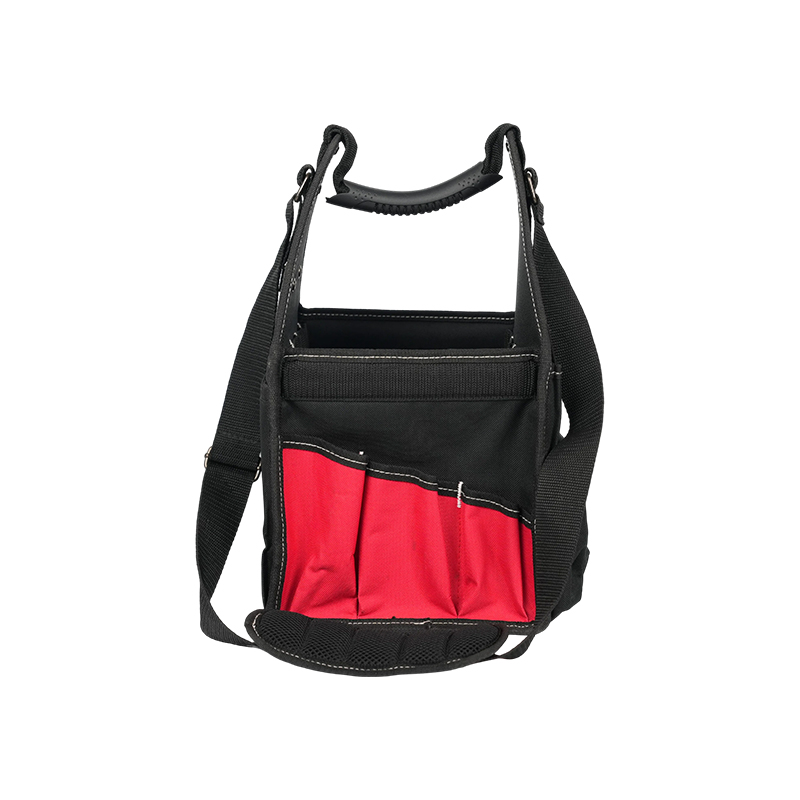 Heavy-Duty Multi-Pocket Tool Organizer with Shoulder StrapThis organizer uses elastic and zippered pockets around a central compartment to keep small parts secure, while its slimmer profile stores flat for quick-grab use.View Product →
Open reel bag with top handle and shoulder strap
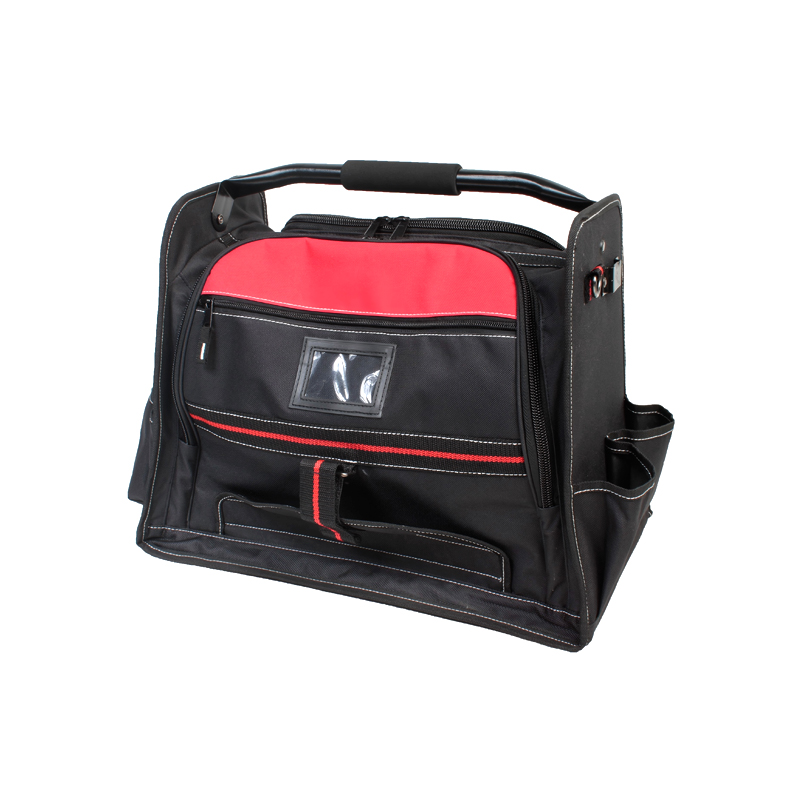
The lightest family trades depth for a slimmer profile that stores flat in a van drawer or inside a deeper backpack. It suits technicians who already run a full carry system and need a quick-grab pouch for short calls.
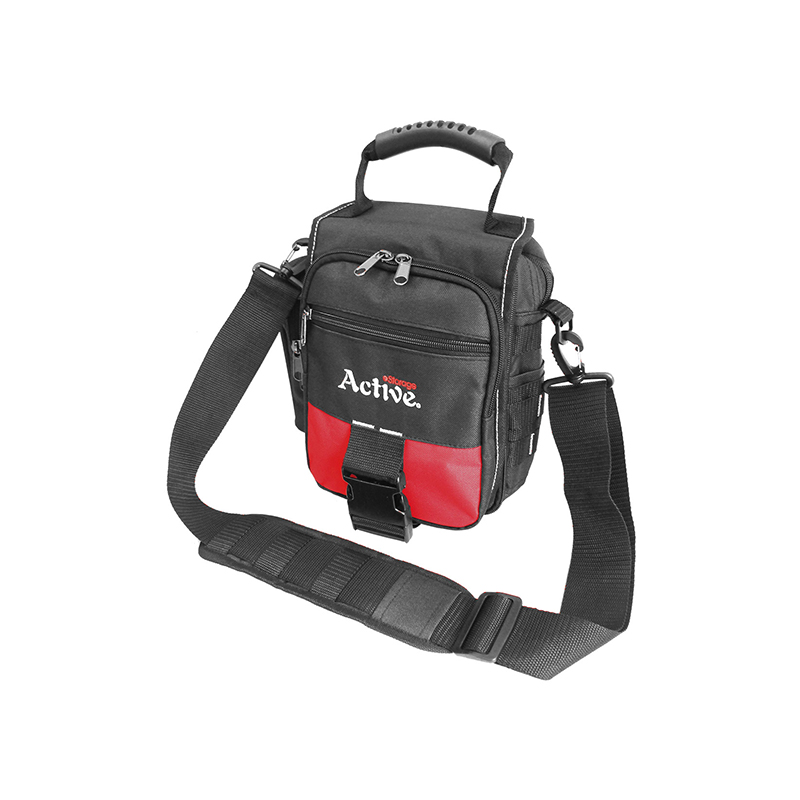
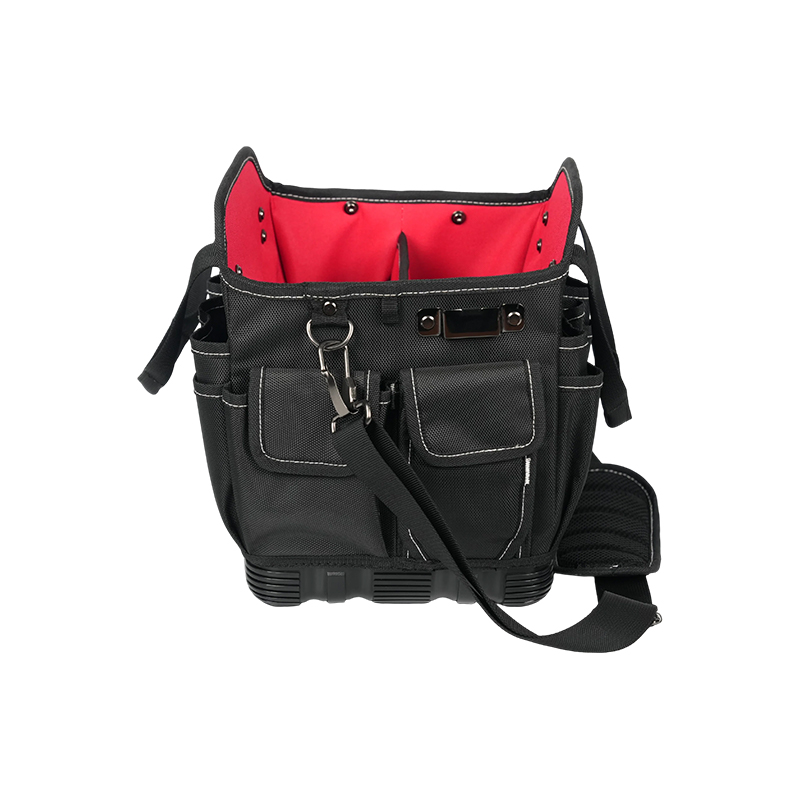 Lightweight Open-Reel Tool Bag with Top Handle and StrapThis bag offers a slimmer, flat-storing profile while retaining open-reel visibility and dual carry options, suitable for technicians with a full carry system.View Product →
All three share a baseline specification: 600D polyester, reinforced stress points, an adjustable shoulder strap, and a base that keeps the bag standing. Order one sample from each family before deciding.
What to inspect before placing an order
The visual finish of a pocket bag is easy to copy; the durability is not. A distributor comparing factories should check five points before confirming a sample.
- Strap attachment points — double stitching or bar-tacking where the strap meets the body; this is the first failure point in daily use.
- Base stiffness — press the center of an empty bag. If it flexes, it will tip over when open and loaded.
- Zipper quality — run every zipper through a full cycle; a slider that skips teeth in the sample will fail within weeks.
- Pocket depth — measure inside pockets against the tool list; a few centimeters of missing depth is a return waiting to happen.
- Fabric coating — confirm the actual denier, 600D versus 900D, and whether the bottom layer is waterproofed.
Beyond structure, buyers usually specify logo embroidery, color blocking, or pocket layout changes. A manufacturer with an in-house design team can adjust the pocket division when the order volume justifies the tooling work — discuss that during quotation.
Sourcing, compliance, and the upgrade path
For global buyers, the factory's audit status is as important as the stitching. Export manufacturers serving EU and North American markets typically hold BSCI, SEDEX, FCCA, or SCS audits. Ask for the latest report and confirm it covers the tool bag production line.
A pocket handy tool bag is the right primary carrier until the inventory passes roughly thirty tools or power tools enter the list. Then workers need shoulder distribution and larger compartments; the trade-off between tool bags and backpacks is worth reading before you commit to a bigger format. Even after upgrading, the pocket bag stays as the quick-access layer, because it can be grabbed from a van seat and opened while walking.
The pocket handy tool bag survives in every serious tool market because it matches the most frequent motion in skilled work: reach, grab, use, replace. For a distributor, that means a stable reorder category with low return rates, provided the structure, stitching, and base stiffness are verified. Start with one sample from each family, test them on real job sites, and build compliance into the early quote stage. The rest is factory discipline.
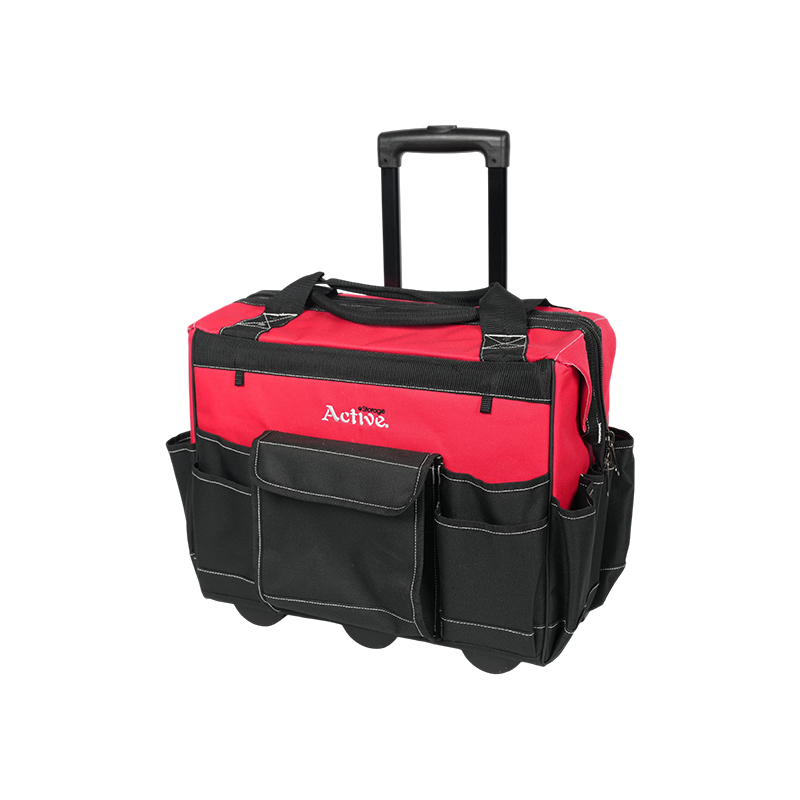



We are a professional enterprise engaged in exporting various types of toolkits.
We firmly believe that 'quality is everything, service enhances value'.
-
+86-15298800699

-
+86-512-58670375

-
karen@kun-bag.com

-
Building 11, No. 93 Chengang Road, Zhangjiagang City, Jiangsu Province, China

Copyright © Zhangjiagang Seaark Tools Industrial Co., Ltd. All Rights Reserved.
Custom Electrician Tool Backpack Manufacturers