
 en
 русский
 Español
 Deutsch

A Practical Guide to Choosing a Multifunctional Tool Bag That Lasts on the Job
A site supervisor once told us that the fastest way to assess a crew is to look at their tool bags. Bags with collapsed mouths, torn liners, and a tangle of cables at the bottom signal a disorganized workflow before the day begins. A genuinely multifunctional tool bag behaves differently: it acts as a small mobile workspace, with a rigid opening, a base that holds its shape on wet concrete, and straps that redistribute weight instead of digging into the shoulders. This article uses the same checklist we apply when reviewing bag designs against real trades, so you can evaluate multifunctional tool bags on structure and behavior rather than pocket count alone.
What "Multifunctional" Actually Means in a Tool Bag
A bag with forty pockets that are too shallow for pliers, too close together for gloved fingers, or positioned where they catch on door frames will slow a worker down. In our experience, multifunctionality comes from three things working together: an opening system that exposes the full interior, a base that holds its configuration under load, and a pocket layout that separates tools by how often they are retrieved. When these three elements are balanced, the same bag can move from electrical service work to light construction without being repacked. When they are not, a high pocket count becomes a liability rather than an advantage.
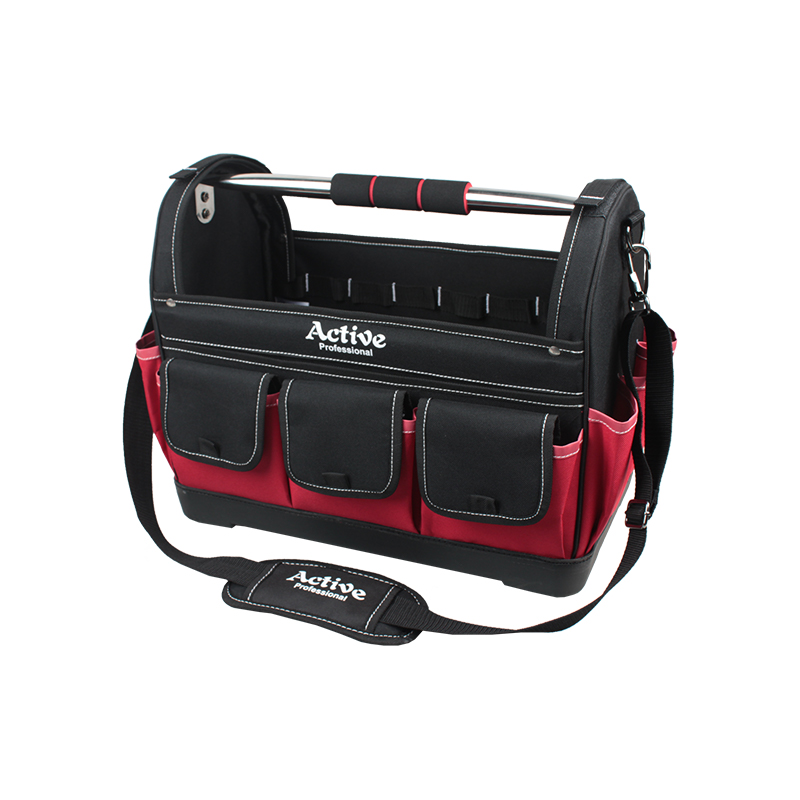
 Hard-Base Multi-Pocket Tool Organizer with Adjustable StrapThis organizer's rigid base and reinforced stitching prevent collapse under load, addressing the funnel effect and pocket layout concerns highlighted in the discussion on professional tool bag design.View Product →
Start with the Base and the Opening
Read a tool bag from the bottom up. A soft, unstiffened base folds inward as tools pile up, creating a funnel effect that pushes smaller items beyond reach. That is why professional designs use a hard molded base, a rubber bottom, or a steel-wire frame integrated into the lower panels. Hard bases protect drill bits and precision tools from ground impact; rubber bottoms absorb drops and reduce sliding on smooth floors; steel-wire reinforcement keeps sidewalls from collapsing when the bag is loaded close to capacity.
The opening matters just as much. Wide-mouth and fully open designs expose the entire tool array at once, which shortens retrieval time on every task. The practical test is simple: reach into the bag with one gloved hand while keeping the other hand occupied. A bag that requires two free hands and a clean bench to access tools defeats its purpose.
| Base construction | Main benefit | Best suited for | Trade-off |
|---|---|---|---|
| Hard molded base | Keeps shape under heavy load | Electricians, installers | Adds weight |
| Rubber bottom | Drop protection and grip | Construction, mixed floors | Slightly stiffer feel |
| Steel-wire reinforced | Stops sidewall collapse | Woodworking, heavy hand tools | Less flexible packing |
| Soft foldable base | Compact empty storage | Casual and light use | Loses shape when full |
Pocket Planning Follows Workflow
Pocket layout is where manufacturing discipline shows. Check the seams: are dividers double-stitched at stress points? Are inner pockets made from the same fabric as the outer shell, or from a thinner liner that will tear after a season of use? We design storage as a hierarchy:
- Deep vertical pockets for screwdrivers, pliers, and long-handled tools.
- Elastic loops for drill bits, markers, and other cylindrical items.
- Zippered compartments for small parts, fasteners, and bits that should never mix.
- Wide external sleeves for items reached hourly, such as tape measures and knives.
A tool bag is not measured by what it holds when it is empty, but by how few seconds it costs when a customer is watching you search for a tool.
The most effective bags usually land in the 20-30 pocket range because that range forces the designer to group functions instead of simply multiplying openings. A gardening tote with 21 pockets, for example, works well because each pocket aligns with a tool type: trowels, pruners, gloves, and labels all have a predictable home.
Match the Carrying System to the Route
The best tool bag is the one that disappears from awareness while you work. On flat indoor routes, a tubular handle and padded shoulder strap are enough. On multi-floor stair routes, a backpack transfers weight from the arms to the back, which makes a measurable difference after the second hour. When the load passes about 15 kg, roughly 33 lb, wheels become the sensible option; trolley configurations reduce fatigue across long access walks and parking lots.
Choosing purely by capacity is the most common mistake. A bag that can hold 50 kg but cannot be carried comfortably to the job is a storage bin, not a tool bag. Our comparison of tool bags and tool backpacks walks through the route-based trade-offs in more detail.
Test the carrying system while the bag is at 80 percent capacity, not empty. The shape of the fully loaded bag determines whether the shoulder strap stays centered or slips off.
Fabric, Zippers, and the Details That Decide Durability
Fabric weight is usually quoted in denier. In professional bags, 600D and 900D polyester are the most common choices. 600D balances weight with abrasion resistance; 900D feels denser and handles dragging over rough floors and sharp tool edges more confidently. Water resistance is a separate question: a coating repels light rain, but a genuinely water-resistant bag has protected zippers and sealed seams at the base, where water pools when the bag is set down.
Zippers are the first point of failure on a cheap bag. Look for coarse-tooth zippers with strong sliders and covered pulls, and check whether the zipper tape is stitched in rather than glued. When sourcing in volume, specify the zipper supplier and the seam stitch density in the quality documentation; these two details account for most warranty returns in this product category.
Pocket count is not quality. We have tested bags with more than 40 pockets that required 90 seconds to find a pair of pliers, simply because the pockets were arranged without rhythm. When judging a sample, time a full tool retrieval from opening to finding the target tool.
Match the Bag to the Trade
Electricians and low-voltage technicians
Electricians carry meters, screwdrivers, pliers, wire connectors, and a set of bits, and they typically move between panels, ladders, and tight corners. The bag needs a protective structure for precision tools and a layout that lets the user identify the right screwdriver by touch. Hard-base backpacks and rubber-base tubular-handle bags handle this movement well because the load stays centered and stable.
 Electrician's Hard-Base Tool Backpack with Laptop SleeveIts hard base and stable frame suit electricians moving between panels and ladders, offering touch-identifiable compartments and a laptop sleeve for daily transport.View Product →
Woodworkers and carpenters
Woodworkers transport saws, chisels, planes, and measuring tools across unfinished floors with debris and open holes. Wide-opening bags with reinforced sidewalls keep long tools visible and protect their edges, while a rigid base limits dust entry and prevents sagging around irregular contents.
 Woodworking Open Tool Bag with Wide Opening and Rigid SidesDesigned for carpenters, this wide-opening bag with reinforced sidewalls keeps long tools visible and protected, while the rigid base minimizes dust entry on rough job sites.View Product →
Field technicians and service crews
Field technicians move between vehicles and client sites on a job list that changes daily. Rolling bags with large openings suit this pattern because the load stays organized in the vehicle and rolls directly to the work area, avoiding repeated lifting and repacking.
What to Verify Before Ordering in Volume
When you buy one bag at retail, you test it yourself. When you buy 500 bags, the supplier's process becomes your quality system. Before committing to a production batch, address three questions:
- Does the factory own its production lines, or is it a trading desk? Real manufacturing capability means pattern engineers, sampling rooms, and the ability to change details during development.
- Are the claimed audits current? Third-party audits such as BSCI, SEDEX, FCCA, and SCS are common in this product category, and a responsible exporter will share certificates rather than describe them.
- How are design changes handled? A factory with its own design patents and prototype development can co-develop a bag with you, instead of relabeling an existing product and calling it customized.
A short practical test beats a long specification sheet. Weigh the empty bag, load it to your stated capacity, lift it by each handle, and time a full retrieval. If the base stays flat, the opening stays open, and the zippers run smoothly under load, the design is structurally sound.
The Bottom Line
A multifunctional tool bag is, at its core, a portable layout system. The base holds the shape, the opening exposes the inventory, the pockets respect the order in which tools are used, and the carrying structure matches the route to the job. When these layers are thought through, the bag stops being an accessory and becomes part of the workflow itself. That is the standard we hold on our own production lines, and it is a practical lens for anyone evaluating an existing tool bag or planning a custom design.





We are a professional enterprise engaged in exporting various types of toolkits.
We firmly believe that 'quality is everything, service enhances value'.
-
+86-15298800699

-
+86-512-58670375

-
karen@kun-bag.com

-
Building 11, No. 93 Chengang Road, Zhangjiagang City, Jiangsu Province, China

Copyright © Zhangjiagang Seaark Tools Industrial Co., Ltd. All Rights Reserved.
Custom Electrician Tool Backpack Manufacturers