
 en
 русский
 Español
 Deutsch

Wheeled Tool Backpack Buying Guide: Match Frames, Wheels and Load Ratings to the Trade
The Wheeled Tool Backpack: Judged by Load, Surface and Trade, Not by Looks
A wheeled backpack that tips, drags or bends its handle costs more than the budget model you rejected. Here is how to specify one that survives a full contract.
A wheeled tool backpack earns its price only when three things line up: the load it actually carries, the ground it actually crosses, and the trade it actually serves. When those match, one bag replaces a tote plus a shoulder bag, and a two-trip walk from the van becomes a single trip.
When they do not match, the same bag becomes dead weight. The telescopic handle bends at the second joint, the base sags under a drill and two batteries, and the crew quietly goes back to carrying everything by hand. That outcome is normally decided at the specification stage, before anything is ordered.
Weigh the Payload Before You Look at Wheel Diameter
A loaded electrician's backpack typically lands between 18 and 25 kg once a clamp meter, hand tools, a cordless drill, two batteries and a parts pouch are inside. Above roughly 20 kg, shoulder carry stops being transport and becomes a short hop from the van to the panel. That is the point where wheels start paying for themselves.
Two numbers decide whether the rolling version works safely. The first is the frame rating: the load the internal frame and handle assembly can carry, repeatedly, without permanent deformation. The second is the fabric rating, which describes tear strength rather than load. Catalogues often quote only the second, because it is easier to test and easier to print.
Before you compare pocket counts, ask four questions:
- What is the rolling load rating of the handle and frame, stated in kilograms?
- How many telescopic sections does the handle have, and what is the extended height?
- Does the base transfer load into a rigid plate, or into a fabric seam?
- Are the wheels a standard diameter that can be reordered as spare parts?
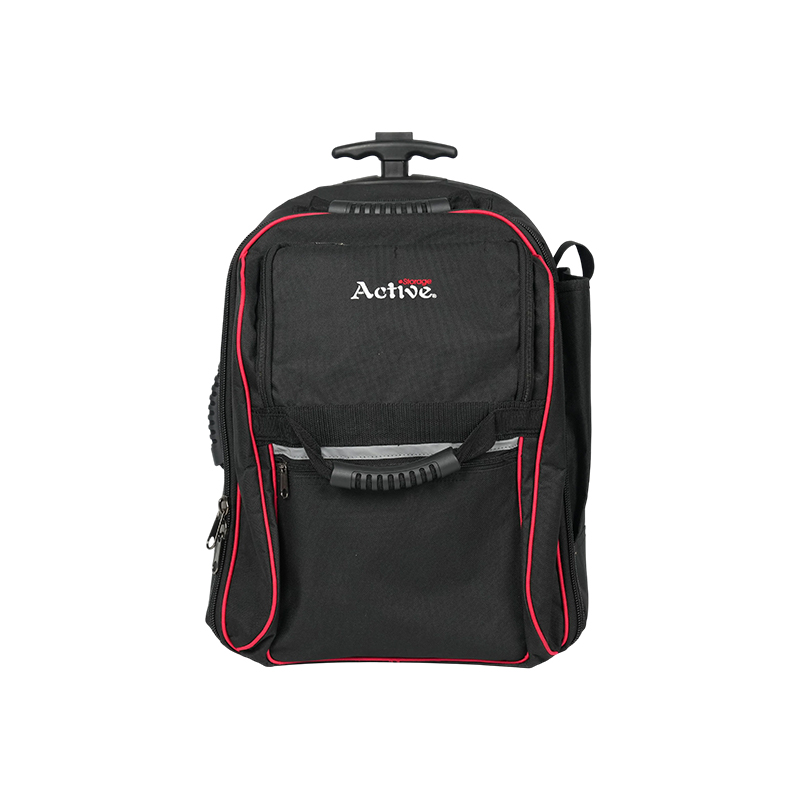
 Heavy Duty Large Capacity Electrician Trolley Tool BackpackThe P024 (39x23x50cm) is a trolley backpack customized for electricians' working habits. Instead of focusing on an excessive number of inner pockets (5 outer, 9 inner)...View Product →
A well-organised bag on a weak frame is still a bag you end up carrying. A rigid base panel and a replaceable wheel set matter far more to the working life of a wheeled backpack than another row of pockets.
Three Wheel Systems, Three Different Surfaces
A telescopic handle with two fixed wheels is the most common arrangement and the cheapest to service. It rolls cleanly on finished concrete, warehouse floors and van ramps, and it puts almost no load on the user's back. Its weakness is steering: with fixed wheels the bag has to be tilted to change direction, which is awkward in a service corridor or a crowded lift.
Swivel, or 360-degree, casters solve the steering problem and take the bag around corners without lifting it. They add rolling resistance and more moving parts, so sealed bearings and a caster assembly you can replace matter on outdoor work.
Large-diameter dual wheels handle gravel, curbs and yard work, but they add weight and bulk to the frame and usually widen the footprint enough to matter if the bag lives on a van shelf.
| Wheel system | Typical surface | Practical load | Main trade-off |
|---|---|---|---|
| Telescopic handle, two fixed wheels | Finished concrete, warehouse floors, van ramps | 20-30 kg | Must be tilted to turn; awkward in lifts |
| Swivel casters, 360-degree | Paved paths, corridors, service areas | 15-25 kg | Castors need sealed bearings to survive grit |
| Dual large-diameter wheels | Gravel, curbs, yards, uneven ground | 25-35 kg | Bulkier frame and wider storage footprint |
| Hard base, no wheels | Stairs, ladders, roof access | Carry only | Full weight returns to the shoulders |
Info: A 100 mm wheel rolls over a 15 mm expansion joint without a jolt; a 50 mm wheel does not. On sites with thresholds, cable trays or grating, wheel diameter affects comfort more than tread pattern does.
 Telescopic Pulling Trolley with 2 Wheels Tool BackpackThis tool bag measures 36x25x54cm. It comes with a built-in telescopic handle and two durable casters at the bottom. These help you lift 44.09 lbs of weight off your s...View Product →
Frames, Bases and Fabric: Where Budget Units Fail First
Most failures on a wheeled tool backpack are mechanical, not textile. The fabric is usually the last thing to give up. The first casualties are a bent handle tube, a cracked base plate, a seam pulled out where the base meets the side panel, or a seized wheel axle. Those four points deserve the specification effort.
The handle is the first part to fail and the last part anyone specifies.
Base construction is the second decision, and three options cover most of the market:
- Hard plastic base with an internal frame: the most rigid option, and the only sensible one above roughly 25 kg. It adds weight and cost.
- Rubber-coated base: better grip and impact absorption on stone and concrete, with a modest weight penalty.
- Padded fabric base: the lightest and cheapest, adequate for light loads and short rolls only.
Danger: Water-resistant and waterproof are not interchangeable. A water-resistant bag keeps rain out of the main compartment; it does not protect instruments through a two-hour downpour, and a waterproof claim without a sealed closure should be treated as marketing copy.
If you are still weighing a modular layout against a fixed one, this comparison of modular tool backpack storage explains how internal panels shift the centre of gravity of a rolling bag.
Matching the Bag to the Trade
Tool lists differ enough that one configuration rarely serves two trades well. The pattern below holds across most site work:
- Electricians: many narrow vertical pockets for drivers and test leads, an opening that holds its shape when empty, and a hard base for van floors.
- Site carpenters: a wide opening and high volume, because saws, squares and bars do not file neatly into slim pockets.
- Automotive and detailing work: low, wide bags that roll under a vehicle and wipe clean; socket edges damage soft linings within weeks.
- Grounds and garden crews: large-diameter wheels, an easy-clean base, and a tote that lifts off the frame for short walks.
- Engineers and maintenance technicians: a backpack that converts to a trolley, carried up stairs and rolled across a plant floor.
Warning: A fixed-wheel trolley on a sloped loading ramp can run away from the user once it passes roughly 20 kg. Where ramps are part of the daily route, specify a brake or a four-caster design instead.
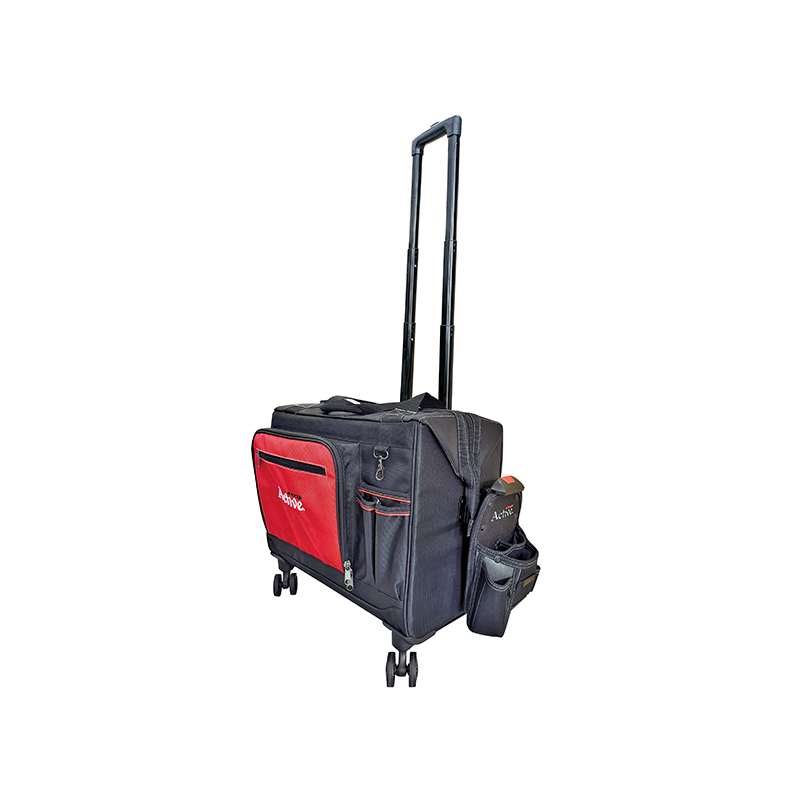 360-Degree Omnidirectional Wheel Silent Rolling Tool BagThe L011 is the pinnacle of maneuverability, specifically designed for professionals navigating tight hallways or crowded construction zones. Its defining innovation i...View Product →
What Trade Buyers Should Put in the Specification
For anyone ordering in volume, the specification document matters more than the sample bag. Samples are usually the best units a factory can build; production is where tolerances drift. Six lines in a purchase specification remove most of that risk:
- Frame and handle load rating in kilograms, stated separately from fabric denier.
- Wheel diameter, tread material and a spare-part reference.
- Base construction type, with the reinforcement method named.
- Seam reinforcement at the base-to-side junction, with stitch density.
- Extended handle height and the number of telescopic sections.
- Carton dimensions and container loading limits, since a wide frame reduces how many units fit a 40 ft container.
Success: Ask for the most recent third-party audit report, the audit body and the date, rather than the certificate logo. Social compliance schemes such as BSCI and SEDEX are renewed annually, and the date tells you how current the factory really is.
A partner with in-house design capability and more than one production site is generally better placed to modify a frame, a base or a handle length than a supplier that only resells a catalogue. That tool bag design and manufacturing capacity is what turns a stock wheeled backpack into a version that fits one specific trade.
Start with the payload, then the surface, then the base. A wheeled tool backpack bought in that order tends to last through several contracts; one bought on pocket count and colour usually ends up back in the warehouse with a bent handle.
Order a sample, load it to the rated weight, roll it across the worst floor on your list, and inspect the handle joint afterwards. Fifteen minutes of testing tells you more about a frame than any specification sheet.




We are a professional enterprise engaged in exporting various types of toolkits.
We firmly believe that 'quality is everything, service enhances value'.
-
+86-15298800699

-
+86-512-58670375

-
karen@kun-bag.com

-
Building 11, No. 93 Chengang Road, Zhangjiagang City, Jiangsu Province, China

Copyright © Zhangjiagang Seaark Tools Industrial Co., Ltd. All Rights Reserved.
Custom Electrician Tool Backpack Manufacturers