
 en
 русский
 Español
 Deutsch

Custom Backpack Tool Bag Specifications: Fix Payload, Volume, and Carry Distance
Custom Backpack Tool Bags: Write the Specification Before You Approve the Sample
A custom backpack tool bag rarely fails because the drawing looked wrong. It fails because the payload, the base construction and the stitch pattern were never written down, and the factory filled in the blanks with whatever was already running on the line.
The short version: fix three numbers before you approve anything. Working payload in kilograms, internal volume in litres, and the distance the user actually walks with the bag on. Those three decisions set the fabric grade, the shoulder anchor strength, the tolerance budget and a large share of the unit price. After that, colour, logo, pocket count and packaging become matters of preference rather than risks to your delivery date.
This is written from the manufacturing side of the table, for brand owners, importers and private-label teams ordering backpack tool bags in production volumes. If you are still deciding whether your end users want a backpack or a traditional tote at all, it helps to compare how the two formats behave on site before you commit to tooling.
Fix the Load, the Volume and the Carry Distance First
Start by weighing a working bag, not the kit list. Water bottles, chargers, spare batteries and consumables all travel in the same backpack, and together they usually add 25 to 30 percent to the catalogue figure. Then add headroom on top of that, because the bag that feels comfortable on day one is the bag that gets overloaded in month six.
- Payload: the tools and consumables the user carries, plus 20 percent headroom. Under roughly 12 kg, a padded back panel and a sternum strap are enough. Above it, the bag needs a load-bearing waist belt and wider shoulder webbing.
- Volume: 30 to 45 litres covers most full professional kits. Pocket-heavy layouts consume space faster than they appear to, and a 30-pocket organiser can swallow 15 litres before a single tool goes in.
- Carry distance: walking more than about 200 metres per trip, or working across several floors, changes the brief from a backpack to a wheeled platform.
That third number is the one buyers most often leave out. Shoulders carry weight well to a point, and across an eight-hour shift that point sits near 20 kg. Beyond it, a backpack built on a telescopic handle and two wheels keeps the same pocket architecture and hands the load back to the ground.
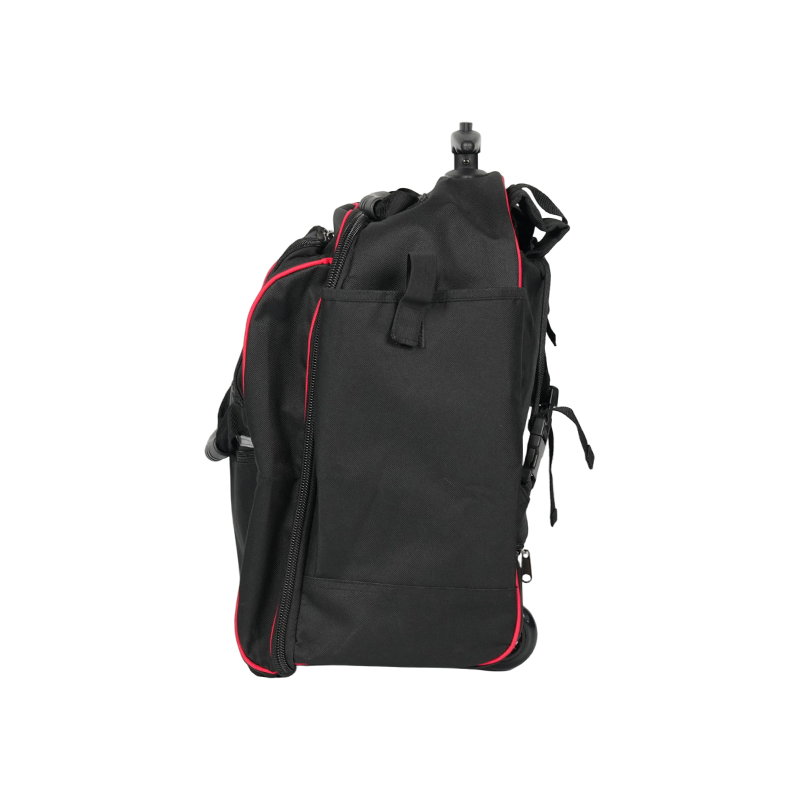 Telescopic Pulling Trolley with 2 Wheels Tool BackpackThis tool bag measures 36x25x54cm. It comes with a built-in telescopic handle and two durable casters at the bottom. These help you lift 44.09 lbs of weight off your s...View Product →
Info: a fast field test is to weigh three technicians' bags at the end of a shift and average the figures. The spread between the lightest and the heaviest is often 6 to 8 kg, which tells you how much strap adjustment range the design has to cover.
Base Construction and Fabric Grade Decide the Service Life
The base is where a backpack tool bag meets concrete, gravel, van floors and kerbs, and it is the first part to fail when the specification is thin. Three constructions dominate custom orders. A high-density polyethylene board of 4 to 6 mm, riveted through the fabric, gives a flat floor and keeps the bag standing when it is set down. A moulded rubber bottom absorbs impact, sits quietly on a van floor and stays flexible in cold weather. Corner foot pads are the lightest option and suit bags that are lifted rather than dragged.
Rivet spacing deserves its own line in the spec. Anything wider than about 60 mm lets the fabric tear between fixing points once a loaded bag is dragged. On fabric, 600D PU-coated polyester is the practical baseline; 1680D takes far more abrasion on rough surfaces at a penalty in weight and cost; 900D sits between the two and is often the sensible choice for a bag that spends more time on a shoulder than on the ground.
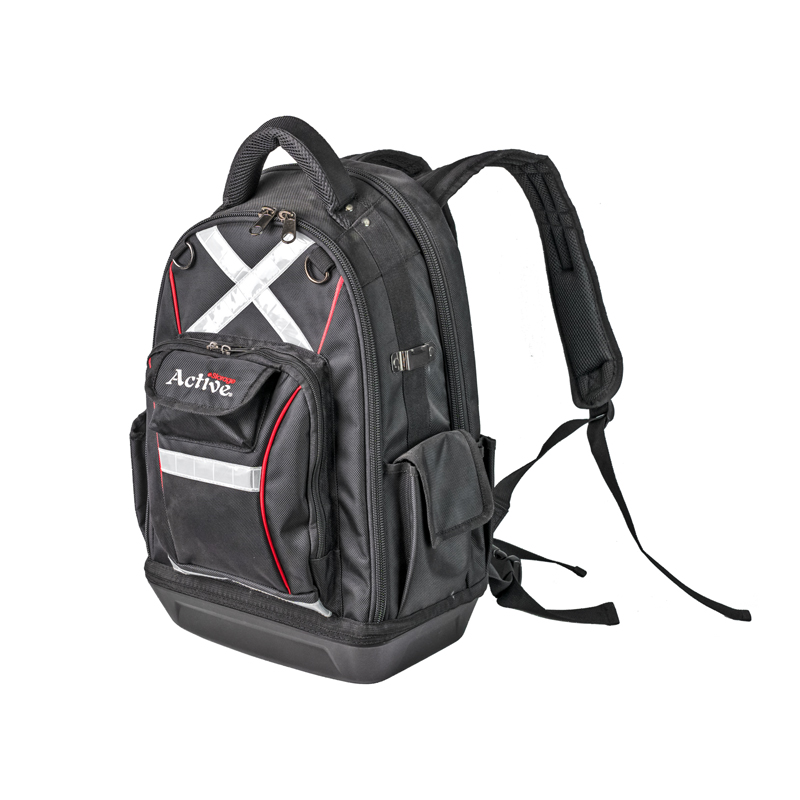 Heavy-Duty Tool Backpack with Hard BaseSafety is at the core of the P015's design philosophy. Its 36x23x53cm dimensions are enhanced by high-brightness reflective strips, significantly improving safety for ...View Product →
Warning: a 25 mm webbing anchor sewn with a single row of stitching will not hold a 20 kg load through a year of daily lifting. Specify bar-tacked, box-X stitched anchors at every shoulder and handle attachment point.
Pocket Architecture: Count Usable Pockets, Not Total Pockets
Pocket count is a marketing figure. Usable pocket count is what a technician notices in the first week. The test is simple: can the most-used tool be reached with one hand while the bag is worn on both shoulders, and can the bag be opened to full width without being emptied first?
Zipper specification matters as much as the layout. A number 8 nylon coil zipper handles internal dividers comfortably. The main opening of a bag carrying 15 kg or more usually deserves a number 10 coil or a moulded-tooth zipper, because the load pushes outward against it every time the bag is set down. Pocket depth should clear the longest tool by 15 to 20 mm, and no more.
| Configuration | Internal volume | Working load | Typical user | Base construction |
|---|---|---|---|---|
| Compact backpack | 28-32 L | 8-12 kg | Service calls, short walks | Fabric base, reinforced corners |
| Full-kit backpack | 35-45 L | 12-18 kg | Maintenance technicians | Riveted hard board base |
| Electrician backpack | 40-50 L | 15-22 kg | Cable, meters, hand tools | Rubber or moulded base |
| Trolley backpack | 45-60 L | 20-35 kg | Long approaches, multi-floor sites | Wheeled frame, hard base |
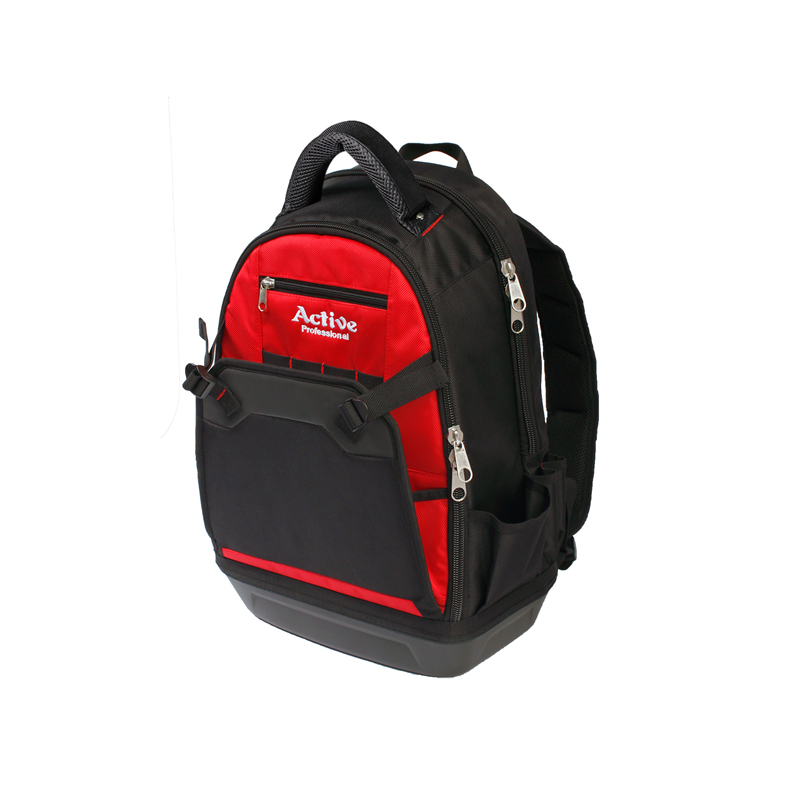 Large Capacity Electrician Tool Backpack with Hard BaseThe P011 measures 36x20x54.5cm. It is designed for technicians who carry heavy wrenches and laptops at the same time. The interior has 25 functional compartments, incl...View Product →
From Golden Sample to Shipment: Tolerances and Inspection
A sample proves a design is possible. It does not prove a production run will match it. The gap closes with three documents signed at the same time: a golden sample, a tolerance sheet and an inspection checklist.
Tool bag tolerances are looser than most buyers expect, which is exactly why they belong in writing. Finished dimensions on a 400 mm panel commonly move by plus or minus 5 mm between lots, stitch density sits between 8 and 10 stitches per inch, and colour is matched against a signed swatch under a fixed daylight lamp rather than a phone screen. Webbing, buckles and zipper sliders should be named by specification, not described by appearance.
A sample tells you what a bag can be. The tolerance sheet tells you what it will be in unit 3,000 of the run.
Inspection is where the savings are. An AQL 2.5 plan for major defects, with no acceptance at all for critical faults such as a failed shoulder anchor or a pulled base rivet, catches the problems that otherwise come back as returns. Compliance paperwork matters just as much: our factories are audited annually by third parties under the BSCI, SEDEX, FCCA and SCS programmes, which is the documentation most large importers ask for before a purchase order is issued.
Success: when the golden sample, the tolerance sheet and the checklist are signed together, a reorder repeats without renegotiating a single detail.
What Actually Drives the Unit Price
Custom backpack tool bag pricing is driven by operations more than materials. Fabric grade is a genuine cost, but the number of stitching operations often moves the price further, because every pocket, loop and reinforcement panel is a separate step on the line.
- Fabric grade and coating: 600D, 900D or 1680D polyester, and the coating specification behind it.
- Hardware: zipper gauge and type, buckle material, rivet quality.
- Stitching operations: pocket count, internal dividers, reinforcement panels.
- Base tooling: a moulded rubber bottom or foot pad needs a mould, amortised across the order.
- Decoration: embroidery, moulded rubber patch, woven label or screen print, each with its own setup.
- Order structure: minimum quantities are usually quoted per colour and per size, so a two-colour launch carries two setups.
Ask for tooling as a separate line rather than folded into the unit price. It is easier to compare suppliers when you can see what you are paying for a mould, and what you are paying per bag afterwards.
Danger: changing the fabric grade or the base construction after the pre-production sample is approved resets the sample, the testing and the schedule, and usually the price. Lock both before tooling begins.
A Custom Programme That Repeats
A custom backpack tool bag programme that repeats comes down to a five-line brief: payload, volume, carry distance, base construction, and the compliance and packaging requirements of your market. Everything else is detail, and detail is the part that is easy to change between seasons.
We have been manufacturing tool bags for export since 2004, working through two factories in China and a production point in Cambodia, with an in-house design team that develops more than ten new designs a year and shares design patents with partners. For custom projects that means a proven platform can be adapted, with pockets moved, base changed and fabric upgraded, instead of starting from an empty page.
If you would like to see which platforms most custom orders are built on, browse the standard tool bag range before you write the brief. Pointing at an existing shape and changing it is faster, and cheaper, than describing one from nothing.
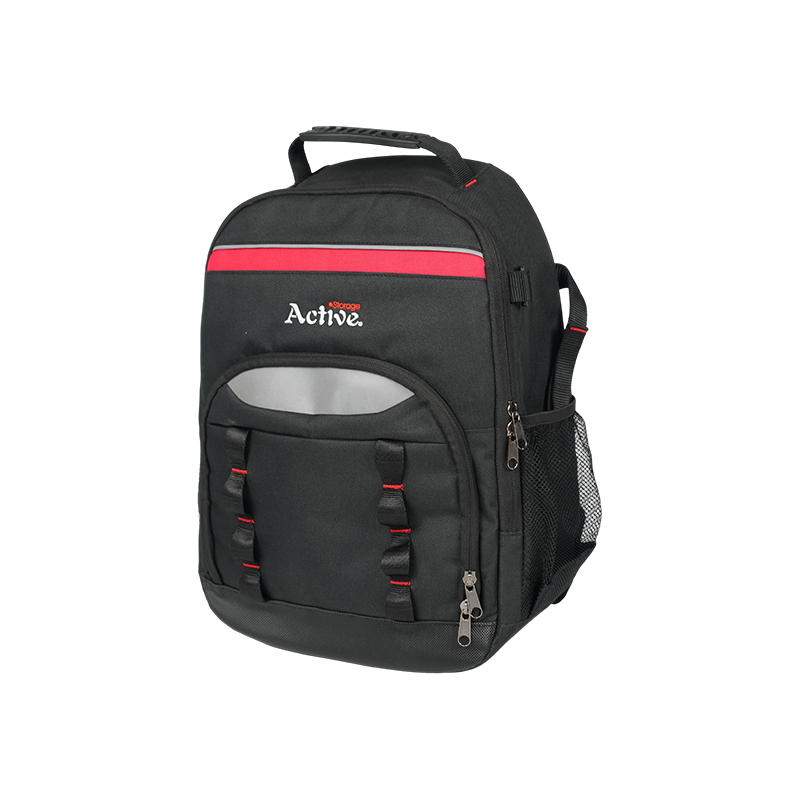



We are a professional enterprise engaged in exporting various types of toolkits.
We firmly believe that 'quality is everything, service enhances value'.
-
+86-15298800699

-
+86-512-58670375

-
karen@kun-bag.com

-
Building 11, No. 93 Chengang Road, Zhangjiagang City, Jiangsu Province, China

Copyright © Zhangjiagang Seaark Tools Industrial Co., Ltd. All Rights Reserved.
Custom Electrician Tool Backpack Manufacturers